 More Eurodance, but this is definitely one of its lesser offerings - there's a lazy, cash in feel to 'Mr Vain' that reminds me of one of those bootleg t shirts hawked outside concert venues. Cheap, but not all that cheerful, 'Mr Vain' takes and applies the genre elements with the economy of Occam's razor, but the flabby oompah beat dances on treacle and Jay Supreme's bull bellow rapping makes Turbo B sound like Nas back on those Snap! tracks. Brit vocalist Tania Evans does her best, but the unimaginative and uninspiring 'Mr Vain' barely gives her lemons to work with; it might pass muster when slotted into the middle of a dance mix, but shorn of its mates to prop it up it just falls flat on its face. It's also with a heavy heart I can report that this was the first single since the early 1950's not to be released on seven inch vinyl and so heralds the beginning of the end of a medium I hold so dear. Ah well.
Monday, 11 April 2011
1993 Culture Beat: Mr Vain
More Eurodance, but this is definitely one of its lesser offerings - there's a lazy, cash in feel to 'Mr Vain' that reminds me of one of those bootleg t shirts hawked outside concert venues. Cheap, but not all that cheerful, 'Mr Vain' takes and applies the genre elements with the economy of Occam's razor, but the flabby oompah beat dances on treacle and Jay Supreme's bull bellow rapping makes Turbo B sound like Nas back on those Snap! tracks. Brit vocalist Tania Evans does her best, but the unimaginative and uninspiring 'Mr Vain' barely gives her lemons to work with; it might pass muster when slotted into the middle of a dance mix, but shorn of its mates to prop it up it just falls flat on its face. It's also with a heavy heart I can report that this was the first single since the early 1950's not to be released on seven inch vinyl and so heralds the beginning of the end of a medium I hold so dear. Ah well.
Sunday, 10 April 2011
1993 Freddie Mercury: Living On My Own
 It's a common enough scenario; an individual commits suicide and former friends/colleagues rally round to express their shock and surprise in a 'we never had any idea' kind of way. Every action or utterance of the deceased is then recalled and analysed for clues as to why they did what they did in a self flagellating search for a covert or coded cry for help that was missed. Of course, Freddy Mercury didn't commit suicide, but the aftermath of his death produced a similar reaction amongst fans and non fans alike and Queen's latter day output was re-cast in the new light shone by the knowledge that Mercury knew he was dying when he recorded them.
So taken on one level then it's easy to read a degree of poignancy into 'Living On My Own' by ignoring the layer of camp to reveal the man beneath pretending everything is ok when it wasn't. It's not quite as simple as that though - originally released in 1985 on Mercury's Mr Bad Guy' solo album, 'Living On My Own' isn't particularly 'latter day' product and it pre-dates Mercury's HIV diagnosis by two years. Even so, the "Sometimes I feel I'm gonna break down and cry, so lonely" doesn't suggest a man at ease with himself either, though the sadness is masked by the tinny eighties disco bounce of the original that lets him sashay all over the top of it with a pantomime drama in typical Mercury style that, with the recurring "Dee do de de, dee do de de - I don't have no time for no monkey business" nobody could ever take too seriously. Certainly not as a cry for help.*
This 1993 model comes spruced up courtesy of a No More Brothers mix that bolsters its flimsiness with a chunky 'Radio Ga Ga' shimmer and backbone that's the equal of Mercury's vocal. It gives it something to bounce off in any case, making it sound like a genuine new Queen single instead of the re-jigging of an eight year old song. And of course, Mercury's death the previous year gives it a context as fresh as the remix which, I must confess, the cynic in me regards as the result of EMI's marketing department scenting financial blood bleeding from an opportune moment. The non cynic however can recognise that the remix is a strong one, and with Mercury on such fine theatrical form then it seems churlish to snipe at what is in fact fitting closure to mark the end of a remarkable career. There would be no more releases in his name.
* You can also read it as Mercury's personal re-write of 'The Great Pretender', a song he covered in 1987 and which itself was re-released in 1993. And taken along with 'Living On My Own', it does in hindsight more than suggest he was trying to tell us something after all.....
Friday, 8 April 2011
1993 Gabrielle: Dreams | Take That: Pray
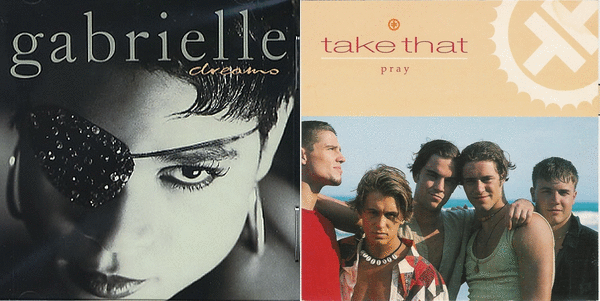 When doing a write up a couple of entries ago, I started setting out an opinion that the number ones were starting to look like a police identity line-up - that is, different, but with enough of a family resemblance to make you have to look twice to be able to tell them apart. Don't look for this; after a quick scan of the songs to come I decided to hold it back specifically because there seemed a more appropriate place to wheel it out. Here.
The nineties for me always had the air of being dominated by certain flavour of the month/year acts who had their day in the sun before being replaced by something else. Nothing new there, it was always thus, but this decade more than others seemed to have more than their fair share of dominant boy band/girl solo singers or a dominant girl band/male solo singers who seemed to either garner a lot of critical acclaim or else they garnered none at all and with a popularity that was either short lived or else had legs. It seemed almost pot luck as to which side of the line they'd fall and yet the output of all was grounded in the same dancey/soul/hip hop based pop groove (with the influencing genres taking more or less of a dominant role depending on the act) that, like a police line-up tended to blend into one sound of bland conformity. And to illustrate what I mean, I'm going to take 'Dreams' and 'Pray' in tandem.
Gabrielle was a London born singer songwriter whose debut single 'Dreams' hit number one. Her Wikipedia entry lists her genres as 'R&B, soul, blues, jazz, urban contemporary and dance'. Take That were nineties boy band par excellence who, to date, have scored eleven UK number ones (unlike Gabrielle, 'Pray' was their seventh single, not their debut). Their Wikipedia entry lists their genres as 'Pop', Pop Rock' and 'Dance'. It's the dominant boy band/girl solo singers I mentioned above and yet played in the background on low volume then both 'Dreams' and 'Pray' sound pretty much the same, two candidates in the 'nineties pop hits' line-up that the non partisan would struggle to tell apart.
Interchangeable certainly - the artists could have swapped songs with little detriment save Gabrielle would have made 'Pray' slightly more urban and Take That would have made 'Dreams' slightly more poppy, but both could/would still have dropped off the same conveyer belt of the nineties hit machine that provided the decade's distinctive/indistinctive stamp of tameness that, by merely skimming the froth off each of those genres and serving it up low calorie lite, smoothes over any jag or hint of originality and individuality.
To be fair, Gabrielle and Take That would not be the only offenders on that front, but as far as the songs at hand go, 'Dreams' goes for the inspirational 'don't give up' message for the rest of us after she's landed her dream squeeze but it's missing that extra gear, that extra key change to get you punching the air with a 'Yeah!' determination. "Dreams can come true" is positive enough, but Gabrielle sings with a curiously downbeat rasp that implies a layer of cynicism she probably didn't intend. 'Pray' is a dream not yet come true where the boys wish an absent female would come back ("All I do each night is pray, hoping that I'll be a part of you again someday"; a scenario that would become something of a theme in anything Gary Barlow wrote). I don't doubt the sincerity, but there's a dullness about the song, like chrome polished so hard that its worn through to the dull metal beneath, with most of the wear coming from the heavenly choir of bricklaying angels backing vocals that pour a jug of very cold water over Barlow's already damp enough squib of a voice.
Both are perfectly acceptable songs and neither set my teeth on edge, but then neither possess anything approaching a spark or bounce, nothing to make me want to turn it up and sing along. In short, neither is any fun. Were they meant to be? Probably not, but then there's nothing here that rewards any kind of in-depth listening either; 'Dreams' would have benefited from the glass half full optimism of 'Pray's arrangement while 'Pray' would have benefited from the slightly more gritty rationalisation of 'Dreams'. But regardless of all that, both are product of the nineties equivalent of Tin Pan Alley and I find it fascinating that two acts who should in theory not be comfortable at the same table are in fact drinking from the same bowl. A harbinger of the decade (and beyond) to come.
Thursday, 7 April 2011
1993 UB40: Can't Help Falling In Love
 If dance music showed that you could paste a hammering beat onto almost anything, UB40 had long since been at hand to show that mostly anything could be given a reggae makeover too. On this, the reggae backbeat provides the flim flam of Presley's original with a stiff backbone to give it a pleasing sense of purpose, but the industrial clang of the percussion and Ali Campbell's whine gives this a coldness at odds with what the message the song is meant to be conveying. But whichever way you cut it this is lazy, by the numbers stuff - another cover version off their conveyor belt of cover versions with no stamp of originality that makes it UB40's own and with their apparent disinterest perfectly mirroring my own.*
* It was around this time that Frank Zappa's touring band were playing a reggae version of 'Stairway To Heaven'. Dread Zeppelin too were doing similar to other Led Zep tracks and both provided an interesting spin on the two genres. Of course, UB40 wouldn't have been able to go out on such a limb without losing their credibility (!?!) as a reggae act, but by playing it so safe they also play it boring.
Wednesday, 6 April 2011
1993 Ace Of Base: All That She Wants
 Though hindsight tends to lump them in with the rest of the nineties Eurodance merchants en-bloc, in truth Sweden's Ace Of Base operated outside the parameters of the genre, basing their sound on chunky beatbox reggae rather than a hip hop/house hybrid. 'All That She Wants' is as good example of this as any, running as it does on a dance skank augmented by doomy horn and spaghetti western whistles. As a floorfiller it does its job, which is just as well seeing as Linn Berggren's flat, exchange student accent has all the neutral engagement of a news reader as she throws the lyrics against the tune in a way that suggests she has no idea what she is actually singing.
Maybe she doesn't - 'All That She Wants' has a double vagueness in that, taken on face value, it's a song about a predatory woman embarking on a series of one night stands solely with the aim to get impregnated. Take it at the level it was meant to be taken and it's a song about a predatory woman embarking on a series of one night stands (with the opening "she leads a lonely life" itself being a vague commentary that can be taken as being either the reason for, or the result of her cavalier attitude to relationships).
But on both levels it's a clumsily executed face off between the awkwardly written ("So if you are in sight and the day is right, she's the hunter you're the fox"), awkwardly sang ("It's not a day for wuh-herk") verses and the relentless nuclear explosion of the chorus. Relentless, now that's a good word to describe 'All That She Wants' - lacking depth or originality, it's main hook steamrollers over it's own shortcomings until it becomes the song's whole raison d'etre, and though I can't find anything of much merit in it, I'm as happy as the next man to sing along. The sign of a good pop song? I guess it must be, though for the want of a nail or two it could have been a great one.
Tuesday, 5 April 2011
1993 George Michael And Queen (With Lisa Stansfield): Five Live EP
 A curious artefact, this 'Five Live EP' contains, as you may have guessed, five live tracks in a sort of mini-album. What might be slightly less obvious though is that, despite the logo and the 'and Queen' blazing proudly on the sleeve and all proceeds going to The Mercury Phoenix Trust, only two of the songs are actually by Queen songs ('Somebody To Love' and 'These Are The Days Of Our Lives') and feature the remainder of the band. What's left are covers of 'Papa Was A Rolling Stone', 'Killer' (the Adamski song) and 'Calling You' from the Bagdad Cafe soundtrack.
 George gets the ball gets rolling strongly enough with a bullish run through of 'Somebody To Love' where he sounds like he's auditioning for Mercury's replacement and singing for his supper at the same time. It carries more than a germ of the hysterical/eccentric swagger associated with Queen (helped by Queen's own hysterical/eccentric backing) but the best isn't saved for last and from then on each track overplays its hand to bog itself down in a welter of professional stodge and fussiness that suggests everyone involved thought a slick band and sense of occasion would be enough to make it all worthwhile.
But it isn't I'm afraid and as a 'live album' it's a failure; nothing here flows with any spontaneity and everything on offer sounds like its been rehearsed a hundred times prior to the recording, with each performance sounding exactly the same. The mix and match nature and presentation of the songs too has the effect of giving the EP the disjointed feel of a mix tape where the loving compiler can see the link that threads the songs together but the rest of us are left in bemusement. And because of that, you almost need two separate sets of ears to listen to it - the Queen songs can be enjoyed as a tribute to the departed Mercury while the remainder can be enjoyed as George Michael flexing his soul muscles on stage, though to that I'd add the caveat that you need to be a diehard Queen fan or a diehard George Michael fan to get any enjoyment at all out of this. If you're both then I guess you're laughing. But I'm not. On both counts.
Monday, 4 April 2011
1993 The Bluebells: Young At Heart
 Now here's a song that weaves a tangled web - during the early eighties, Bluebells vocalist Bobby Bluebell was dating Bananarama's Siobhan Fahey and wrote 'Young At Heart' for inclusion on the girl's 1983 'Deep Sea Skiving' album.* An unremarkable clump of candy floss frump in its original form, The Bluebells re-worked the tune into a Cajun barndance reel and released it in their own right in 1984 where it reached number eight. Fast forward nine years and it was picked up by Volkswagen for use in a rather cynical 1993 television advert that took the "Old before their time, they married young" lyric literally to celebrate the virtues of divorce. The inevitable re-release took the song to number one, which is where we find it now.
Hailing from Scotland, The Bluebells themselves purveyed the jangly indie kid sound popularised by Scotland's own (immensely influential) Postcard Records but without its left field, off kilter credibility. True, 'Young At Heart'' has the scratchy, wiry sound of a Josef K or early Orange Juice (acts actually on the label), but its re-jigged chorus goes for the commercial jugular with a force of repetition that irritates rather than endears over its running time. In point of fact, the Volkswagen advert itself lasts for a mere 45 seconds and over that brief time 'Young At Heart' spills all of its beans - the remainder simply circles itself like water down a plughole. The 1984 'Young At Heart' shoved a rootsy (and welcome) two fingers up to its electronic/new romantic chart peers, but some ten years on it's garnered the gimmicky inauthenticity of a made up dance of yesteryear and has the awkwardness of a game mature student in a hall of residence full of freshers. Not bad, just unnecessary.
* I'm led to believe that Fahey's co-write credit was given out of love rather than any actual input and that Bob was mightily peeved when she received a huge chunk of the royalties from its second wind here. No doubt he was even more peeved when violinist Bobby Valentino successfully sued in 2002 to be credited as co-writer himself for coming up with the distinctive electric fiddle riff.
Subscribe to:
Posts (Atom)
