Tuesday, 9 August 2011

1997 Spice Girls: Who Do You Think You Are/Mama

A double A side from the girls, but only one of them need detain us for long - 'Who Do You Think You Are' is a Hydra headed tune that's part Europop, part seventies funk, part disco and with House overtones that are all homage to Madonna's 'Vogue'. So many cooks could have spoiled the broth, but each ingredient is used sparingly and in pinches to create a song that's low on calories but high on an effortless joi de vivre that even manages to counter that awkward shift of key and tempo at the "Swing it, shake it, move it, make it" breakdowns. There's nothing new here of course, but take it on it's own terms and it does the job of keeping the dancefloor ticking over.

'Mama', on the other hand, is the sickly confection of the girls paying tribute to their mothers who once upon a time "used to be my only enemy and never let me free, catching me in places that I know I shouldn't be" but now, older and wiser, they're happy to admit "so now I see through your eyes, all that you did was love. Mama I love you" in an updated 'There's No One Quite Like Mama' style. It was probably a godsend for the lazy at Mother's Day and cheaper than a box of chocolates too, but it's too much 'Strawberry Kiss', soft centred goo for me to cope with I'm afraid - stick to the 'Hazelnut Heaven's girls.*


* Fans of Cadbury Milk Tray will know what I mean. Oh yes.


Monday, 8 August 2011

1997 No Doubt: Don't Speak

Originally a ska/punk crossover band, No Doubt's 'Don't Speak' is gimmick free rock balladry that boldly walks the fine line separating the overground from the underground, with the ever photogenic Gwen Stafani effortlessly exploiting the duality of the mainstream appeal of Madonna and the alt rock credibility of Courtney Love. "As we die, both you and I, with my head in my hands I sit and cry " - 'Don't Speak' is an angsty wail all right, but it keeps it's pecker up with a fist pumping, mosh friendly chorus that welcomes everyone to the party, and therein lies the problem - for a band riding the vague wave of West Coast, punk inspired skate/guitar/rock acts (along with Green Day, The Offspring, Primus, Rancid etc), the smooth edged 'Don't Speak' is the rock ballad Celine Dion would record if she ever wanted to show she's down with the kids. Which is to say that it's a little on the drive time bland side for my tastes, and though it never fails to catch my ear it never quite manages to hold my interest.


Friday, 5 August 2011

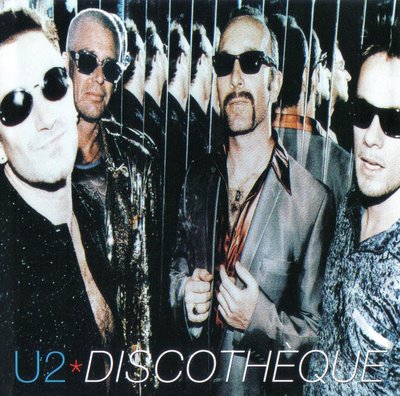
1997 U2: Discotheque

What is it about U2 that I just can't take to? It's a fair question, and one that I've considered off and on over the past twenty years or so, usually around the time they release a new album and when I invariably find myself not liking it. It's not so much an out and out hatred that I have, but I've never been able to deal them on any level whereby their music gives me an unalloyed pleasure. There's been the occasional song yes - any band active for so long would struggle not to produce at least something worthwhile. But for every moment of clarity that takes our relationship step forward, the band - either individually or collectively - will do something that irks enough to shove them back three paces and have me clamouring for a divorce.

It's not just down to Bono either. I know his extra curricular activities of charitable worthiness are a lightning rod directing mass loathing for many, but I can't say they've ever bothered me all that much. I find it very easy to separate Bono the singer from Bono the UN Peace Ambassador (or whatever) simply because I find Bono a very easy person to ignore. Full stop. Which is odd in the context of U2, because for a man with seemingly endless things to say outside of his band, he never has much to say for himself when he's with them.


Take 'Discotheque' for example. A direct continuation of U2's post-modern 're-invention' that began with 'The Fly', 'Discotheque' lays on a similar junkyard wall of sound but this time it's sifted through a dance filter that softens the hardness into something more fluid. Yet for all its silicon valley industrial montage of 'can't stop' busy-ness, 'Discotheque' is as hollow as a blown egg with only its own noise and a vague sense of their newly found irony (a dance track from the future called 'Discotheque'? Oh how very droll) holding it all together. This U2 Mk2 always have an in-built aspiration to lead the pack, but in their blinkered attempts to predict or ride the zeitgeist, they usually find themselves one step behind it. Yet crucially for them, at the same time they're always enough of a step to the left of it to give their music the impression of originality and innovation, even when the actuality is the exact opposite.


On 'Discotheque' the cut up lyrics ("You know you're chewing bubblegum, you know what that is. But you still want some, you just can't get enough of that lovie dovie stuff" - what does it mean? Not the foggiest sorry), car crash guitars and newly found dance angles are crude image panels from a simple zoetrope that only give the illusion of movement by virtue of moving so quickly. Slow it down enough to scratch the glossy painted surface and it reveals the lines and numbers of the template beneath that the band painstakingly painted it by, and with no apparent joy either. And when the band themselves don't sound like they're enjoying it much, then it doesn't bode well for the rest of us. Not for me anyway; like most of their output, I don't hate it, but then I don't like it much either.


Thursday, 4 August 2011

1997 LL Cool J: Ain't Nobody

From the soundtrack of 'Beavis & Butthead Do America' (which isn't the world's strongest opening gambit), 'Ain't Nobody' is a cover of the 1984 Rufus & Chaka Khan dance classic. Not just a cover version mind - a rap cover version, which is a statement that by itself puts me on caution from the threat of what that might entail. The Fugees have already conveniently demonstrated the two main directions this could go and, unfortunately, 'Ain't Nobody' is more 'Killing Me Softly' than 'Ready Or Not'.

Chaka Khan's vocal on the original is the secular gospel celebration of finding that special someone directed to that special someone. This re-working throws a lead weighted net over the uplift by adding a very workmanlike rap of smarmy smooth talk ("I'm the best when it comes to makin' love all night, throw your butterscotch body beneath the red light") that you just know LL spins to all the girls and by itself it puts a crack in the once clear bell of the chorus until it no longer rings true and serves to compres the song until it's as flatly drawn as Beavis and Butthead themselves. All very lazy, all very forgettable - the main point of interest of 'Ain't Nobody' is as an illustration of how quickly the novelty of seeing rap at number one has faded.


Wednesday, 3 August 2011

1997 Blur: Beetlebum

By 1997 with the 'battle' with 'rivals' Oasis lost , Blur began moving away from the knees up romp al la 'Country House' (in an "if you can't beat 'em, don't compete" kind of way) to an altogether different place that took inspiration from the post grunge, lo-fi music scene filtering in from across the Atlantic. Damon Albarn had of late been trumpeting the virtues of Pavement to anyone who'd listen and promised in advance that the new Blur album would be more than one step removed from the dying on its arse Britpop movement. He wasn't kidding either; simply called 'Blur', the album was as fresh a start, line drawn in the sand affair as its definitive title suggested and lead off single 'Beetlebum' presented a more gritty aura than previous.

In hindsight it seems obvious, even without subsequent confirmation from Albarn, that 'Beetlebum' was a song about drug use; "And when she lets me slip away
, she turns me on all my violence is gone, nothing is wrong, I just slip away and I am gone". Yet 'Beetlebum' escaped the furore that surrounded an 'Ebeneezer Goode' by virtue of its tone and ambiguity; there's nothing celebratory about Albarn's descriptors, they're as matter of fact as Lou Reed's "Heroin, it's my wife and it's my life", but while Reed's song builds slow before descending into a hell of squally noise, 'Beetlebum' opens with a guitar led dirge in a box that gives way to the widescreen chorus that breathes freely with some very Beatle-esque harmonies to give voice to the pleasures of a heroin high.

Ah but hindsight too has shown that though this seemed a brave step leftfield at the time, its edginess flatters to deceive; I'm always happy to trust my own ears, and here they're telling me that they've heard all this before. There are plenty who have strip mined the cod-violent gun/cum imagery of 'Beetlebum' (contemporaries Suede for one, though Albarn would not welcome the comparison) to better effect than its designer rough and Albarn's own 'one of the lads' twang can manage. Which means that there's nothing new about 'Beetlebum' beyond the novelty of its own existence, and though it breaks new ground for Blur, the paths it follows have been well trodden by others before it. And trodden to much better effect to be honest.


Tuesday, 2 August 2011

1997 White Town: Your Woman

A subtle spin on Bing Crosby's 1932 song 'My Woman' (though the muted trumpet riff is actually a direct sample from Al Bowly's version of the same year), 'Your Woman' is a soft clash of the old and the new from one man band Jyoti Prakash Mishra (aka White Town) that's broadcasting from some unspecified, androgynous future through a vintage radio microphone powered by valves. 'Your Woman' works as a song because it neither revels in nor emphasises this inherent contradiction in style and instead presents both itself and its curiously asexual lyric in a dry and passionless, matter of fact way that stops it well short of falling into the territory of quirk to demand that you take it seriously. Indeed, 'Your Woman' feels more closely aligned with the then lo-fi output of Folk Implosion, Pavement, Beck et al (though that spooky trumpet motif is the best sample Portishead never used), a comparison that befits a song recorded in a back bedroom. It all adds up to a noteworthy one hit wonder of the kind we haven't seen in such a long, long time.


Monday, 1 August 2011

1997 Tori Amos: Professional Widow

As part of his nineties Radio One Radio Show, media terrorist Chris Morris used to present a weekly spoof 'Dance Top Ten' run-down: "Forty-ninth week at seven, it's still there for Oestrogen Blabdaddy and "Bring Me A Chicken". Down twelve at six, there they sit, Urbane Bookie Collective and "Dreamy Twat." And also at number six, due to huge shopping, Denis Helium and his remix of ELP's "Anaesthetics At The Birth Of A Potato." Up more than I care to say, with their first major number five, it's Love Minus Petrol and "Blundering Around In A Tent". If he'd added "And at number one, Armand Van Helden's house remix of Tori Amos' 'Professional Widow" then I don't think it would have looked too out of place in its unlikeliness.

And yet here it is, a spoof made flesh at number one. I've said in the past that it's no great shakes to graft a thumping 4/4 backbeat over anything and present it as a 'dance remix', but Van Helden goes much further than such simplicity to completely re-construct Amos's original harpsichord led swipe at Courtney Love (originally a 1996 double A side with 'Hey Jupiter') from the ground up until only the DNA of her vocal remains, and even that is sliced and diced until her "Honey bring it close to my lips" is reduced to a hard garble to bounce off Helden's snakeskin bassline. In fact, Helden's work reduces Tori to a bit part player struggling to belong in her own song. 'Own song'? - this is now as much a Tori Amos song as replacing the head and handle of a broom makes it the same broom, and I don't know what impresses the most; that Helden's vision saw the potential in the source material in the first place or that he actually pulled it off. Philosophical niceties aside though, this is simply a great dance track.